In her first few years as an undergraduate student at the UW, Natalie Mazzawi did not see herself in a lab. Participating in research wasn’t on her radar. Beginning college as COVID-19 restrictions were coming to an end, she was juggling the transition between a return to in-person learning and the laborious classwork of a pre-health student; her entire focus was on keeping her head above water.
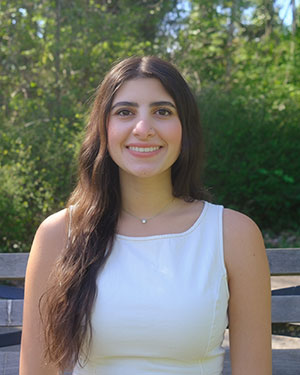
But while searching for a field to home in on during her sophomore year, Natalie’s advisors encouraged her to get involved with a research lab.
“I struggled with a sense of imposter syndrome,” she said. “I assumed undergraduate research was reserved for ‘exceptional’ students and didn’t see myself as part of that group. However, following my advisor’s suggestion to strengthen my background, I decided I had nothing to lose. In hindsight, it was one of the best decisions of my educational career.”
Flash forward to the present day and not only is Natalie a first-year student in the UW School of Dentistry, but she also played a huge role in an award-winning research project that was honored as the best paper published in the Journal of Dental Research in 2025.
Though she never anticipated she would be spending part of her undergrad responsible for periodontal cell culture maintenance and helping create a 3D model of a periodontal ligament, through the extensive research network at the University of Washington, Natalie dove headfirst into interdisciplinary lab work and came out of the other side a better researcher, student and person.
Finding a Research Home
As a second-year undergraduate student with a newfound determination to get involved with a research project, Natalie first got to work by cold emailing as many labs as she could.
“I reached out to 20-30 labs across molecular biology, genetics and public health — essentially anything that aligned with my major and background,” Natalie said.
With not much sticking early on, a family friend recommended she get in contact with Dr. Nathan Sniadecki of the UW Department of Mechanical Engineering and Bioengineering, who runs a Cell Biomechanics Lab at UW. After reaching out and expressing interest in his cardiac cell biomechanics work, Dr. Sniadecki invited Natalie to attend lab meetings for a few weeks to explore potential projects.
It was there that she sat in on the work of Dr. Priti Mulimani, a UW School of Dentistry graduate student whose research on periodontal ligament (PDL) biomechanics was beginning to take form.
“Although I knew nothing about the periodontal ligament and had never considered getting involved in dental research, Dr. Mulimani and I had instant chemistry,” said Natalie. “Beyond respecting my schedule and goals for research, she was kind and genuinely interested in getting to know me. This research was her passion project, and that was so evident in our first meeting that I became excited to be a part of the work and see what it would become.”
In January of 2022, Natalie officially began working alongside Dr. Mulimani on her periodontal tissue construct project.
Creating a Periodontal Ligament
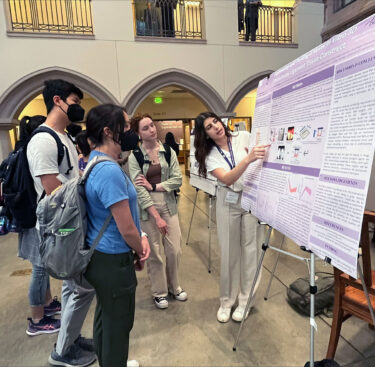
Dr. Mulimani’s research used premolar cells to create 3D models of a PDL, the narrow band of tissue that connects teeth to the jawbone.
The models, labeled Periodontal Tissue Constructs (PTCs), were complex and difficult to make because of how small and inaccessible PDLs are. But through years of consistent research, hard work, and ingenuity, the project ended up as a resounding success.
Their final paper, titled “Engineered 3D Periodontal Ligament Model with Magnetic Tensile Loading,” received the International Association for Dental Research (IADR/AADOCR) 2026 William J. Gies Award in the Biomaterials & Bioengineering category.
“I worked closely with Dr. Mulimani for over two years, starting from my sophomore year until my graduation,” said Natalie. “This project allowed us to develop and execute a highly efficient pipeline for the complex PTC fabrication technique.”
In the Author Contributions section of the paper, Natalie is credited as having contributed to “data acquisition and analysis” and “critically revised the manuscript.”
“I dedicated extensive time to fabricating the mechanical components required to cast the tissue constructs, such as the silicone post arrays,” she said. “My role also involved managing the majority of cell culture workflow and processes, which included preparing specialized media, thrice a week feeding, passaging or freezing cells, and treating them with reagents when needed for experiments.”
Natalie was a key part of the research engine, shouldering a substantial burden of day-to-day tasks to make sure that the cells were properly taken care of and ready for testing, not just for weeks or months, but for years.
Thankfully, she had great mentors in Dr. Mulimani, Dr. Sniadecki and Dr. Tracy Popowics, another principal investigator on the PDL project and a professor in the UW Department of Oral Health Sciences, who were incredibly motivating and demonstrated the vital impact of dental research.
“My time in their labs revealed how fulfilling and intellectually stimulating the discovery process can be, which has directly motivated me to seek out new research avenues,” said Natalie.
Natalie eventually decided she would apply to dental school at the end of her undergraduate studies. However, she walked away thankful to have been involved with an interdisciplinary project, immersed in a field she might not have encountered otherwise.
“I am grateful to have worked at the intersection of dentistry and bioengineering; contributing to our understanding of the mechanical properties of human tissue was a highlight of my education,” she said. “Bridging these fields gave me a unique perspective on how engineering principles can advance dental science.”
School-Life-Lab Balance
Perhaps the most daunting part of working in a lab as an undergraduate is not the complex operations or the handling of expensive equipment, but instead the time-consuming nature of it all.
For starters, even getting a foot in the door of the lab can be a tall task. Natalie only received five responses out of the nearly-30 emails she sent out offering free help.
“One thing I kept in mind is that professors get so many emails that you won’t be the only name in their inbox, so often success is just about emailing at the right time,” she said. “Putting yourself out there is hard, but people recognize that vulnerability and really respect it.”
For students who want that leg up in getting involved, Natalie recommends that, if there’s a professor they really like, talk with them outside of class about opportunities in their labs, or ones adjacent to them. If there’s a subject they have in mind, reach out to a faculty member in that department and display interest. “The most important thing is not to be afraid of rejection,” she said.
But powering through those initial hurdles is worth it, says Natalie, because the opportunities for growth and development as a student are second-to-none.
“Research can often unlock interests in niche fields you may have never considered, potentially shifting your entire career perspective,” said Natalie. “Plus, having a responsibility outside of your coursework multiple times a week forces you to hone your time management skills, which is essential for dental school and life in general.”
And on top of it all, research can lead to real-life changes. Natalie is a perfect example of how just offering help at the right time can lead to having a hand in groundbreaking discoveries and innovations.
PTCs may eventually be used to reconstruct entire rows of missing teeth, and Natalie played an instrumental role in that development.
Just Getting Started
Now that her work in the Sniadecki Lab has wrapped up, Natalie has her sights set on more research opportunities at the School of Dentistry.
She’s currently pursuing a 2026 Summer Research Fellowship (SURF) project where she will be exploring the role of parents’ childhood adverse events on their children’s dental fear and behaviors.
In many ways, it would be sufficient for Natalie to note that she was a research assistant for a nationally recognized, award-winning project on her resume and let that lone project speak for her diversity as a professional. However, she now recognizes the importance of research in her growth as a future dentist.
“In my experience, research has taught me so much about myself, specifically regarding my work ethic, time management, and resilience,” said Natalie. “As I continue to progress through dental school, I believe that staying involved in research will continue to complement my clinical education and my overall development as a dentist. UW offers a robust research environment that is incomparable to many other institutions and stands as a leading contributor to global discovery.”
“It is a unique privilege to have the tools to follow my imagination and add productive work to the field that I am going to spend my life in, contributing to a body of knowledge that will hopefully make people’s lives better,” she said. “In my opinion, letting that avenue fall to the wayside would be a waste of an incredible opportunity.”