The International Association for Dental, Oral, Craniofacial Research (IADR/AADOCR) has selected Dr. Tracy Popowics and her team of UW researchers as the recipients of the William J. Gies Award for Biomaterials & Bioengineering, given to the best paper published in the Journal of Dental Research during the preceding year.
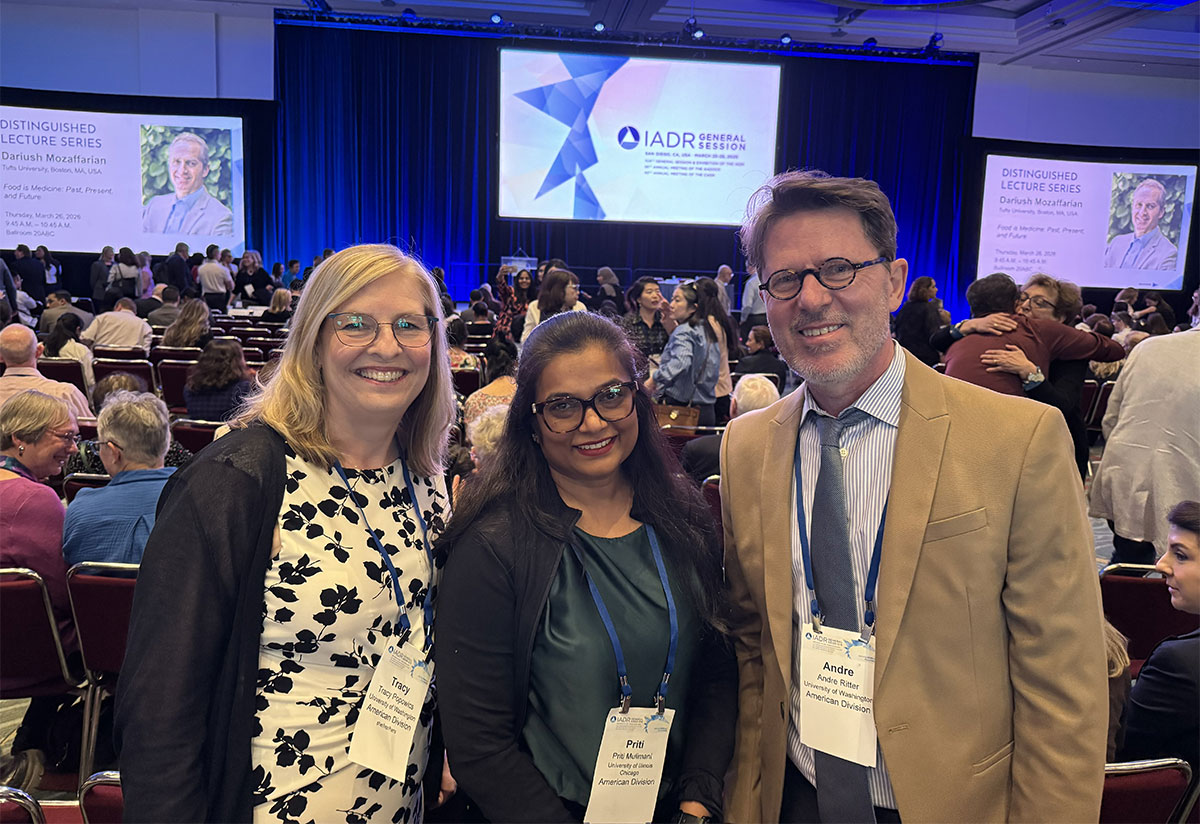
“The Journal of Dental Research (JDR) is a highly respected and high-impact journal,” said Dr. Whasun Oh Chung, the UWSOD’s current Associate Dean for Research. “This recognition by JDR and its selection committee highlights Dr. Popowics’ contributions in biomaterials and bioengineering research. It is a testament that her pioneering work is respected internationally and speaks to her stature in her field.”
The award-winning paper, titled “Engineered 3D Periodontal Ligament Model with Magnetic Tensile Loading,” provided the proof of principle for the creation of a 3D model that emulates some key structural and functional features of the human periodontal ligament (PDL), which is a narrow band of tissue that connects teeth to the jawbone and supports the tooth during chewing.
A healthy, functioning PDL is critical to preventing tooth loss. Because of the PDL’s small size and difficult-to-access location, the cellular and mechanical functions of the PDL are difficult to study in living tissue.
“Our study has produced a three-dimensional model of the PDL that replicates the cellular and mechanical functions of living tissue,” said Dr. Popowics. “This model enables the study of complex processes such as orthodontic loading at the cellular level.”
Prior 3D lab models of the PDL have existed previously; however, none could simulate realistic tensile (pulling) forces. This new model, labeled a Periodontal Tissue Construct (PTC), mimics a PDL in its responses to mechanical influences.
“The ability to reorganize and rebuild the PDL will have a significant impact on future dental treatment,” said Dr. Chung. “Rebuilding functional ligament tissue will improve periodontal therapies, while PDL remodeling will help with more precise orthodontic planning.”
The PTC can be used to further research and therapies towards eventual PDL reconstruction. While the model is not yet perfect, the fact that they can create living tissue constructs that behave much closer to real PDLs is enlightening for the treatment of tooth loss, periodontitis (gum disease) and reconstructive dentistry as a whole.
“Our team is very honored to receive this award and to have the approbation of the international dental research community,” said Dr. Popowics. “Receiving the award also emphasizes the value of interdisciplinary collaborations, in our case between mechanical engineering, oral health science and orthodontics.”
Other researchers on the paper alongside Dr. Popowics include Dr. Priti Mulimani, UW Department of Oral Health Sciences; first-year UW School of Dentistry student Natalie Mazzawi; Alex Goldstein, Ava Obenaus, Daniel Truong, Dr. Nathan Sniadecki, UW Institute for Stem Cell and Regenerative Medicine; and Sophie Baggett, Department of Biology, Carleton College.